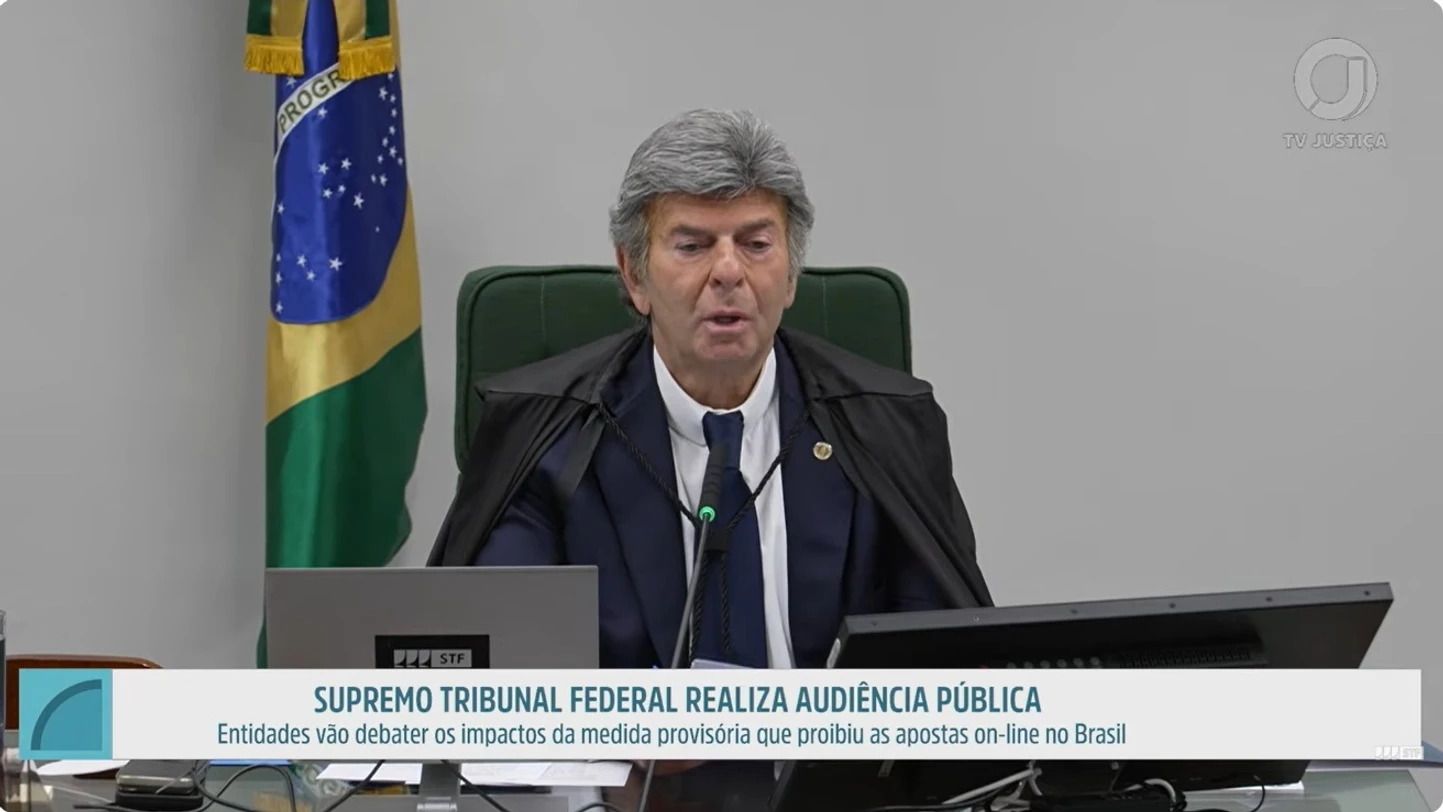
Brazil Supreme Court Holds Hearing on Betting Ban Measures
Brazil Supreme Court Reviews Betting Ban – Industry and Government Clash Over Provisional Measure
Key Takeaways
- Brazil’s Supreme Federal Court held a public hearing with 34 entities to review the betting ban under Provisional Measure 1.394.
- Government ministries argued the prohibition is necessary to protect families from gambling-related financial and social harm.
- Industry groups challenged the measure, highlighting concerns over abandoned investments like the BRL30 million ($5.5 million) authorisation fees.
- Researchers proposed eight operational conditions to allow a regulated market to function safely.
- Minister Luiz Fux will determine the next steps, leaving the immediate future of the sector unresolved.
Government Officials Defend Immediate Prohibition
The Brazilian government maintains that banning betting activities is a necessary step to protect citizens. Representatives from the Ministries of Justice, Health, and Finance joined the Attorney General’s Office (AGU) at the Supreme Federal Court (STF) hearing. They argued that the previous regulatory framework failed to shield families from the financial and social consequences of gambling.
Justice Minister Wellington Cesar Lima e Silva categorized betting platforms as an architecture of unspeakable dependency. He told the court that implementing Provisional Measure 1.394 was a relevant and urgent action for public welfare. The government views the suspension of betting as a necessary reset for public policy.
AGU head Jorge Messias stated that licensed operators had made efforts under the previous rules. He argued that the state still holds the responsibility to review policy based on its outcomes. Messias claimed the prior regulatory framework had become materially unconstitutional because it offered insufficient protection for constitutionally protected assets.
Industry Representatives Warn Against Unregulated Markets
Betting operators and associations focused their arguments on legal certainty and the dangers of a sweeping ban. The National Association of Games and Lotteries (ANJL) filed Direct Action of Unconstitutionality 8027 to seek a suspension of the provisional measure. Representatives argued that prohibiting legal operations simply drives consumers toward unregulated and clandestine platforms.
The Brazilian Institute for Responsible Gaming (IBJR) requested an injunction from Minister Luiz Fux. IBJR representative Celso Mori pointed out that Brazil had previously opted for a regulated market through years of legislative processes. He criticized the sudden policy reversal, stating it creates an environment for irregular gambling.
Broadcasting stakeholders expressed frustration with the sudden regulatory shift. Gustavo Binenbojm, representing the Brazilian Association of Radio and Television (Abert), challenged the use of a provisional measure to dismantle a framework built by Congress and the Executive branch. He noted that the original regulation was a pragmatic choice meant to keep the market out of the hands of organized crime.
Stakeholders Demand Answers on Existing Investments
The sudden implementation of the ban left companies that acquired licenses under the old framework in a precarious position. Industry advocates and sports clubs questioned the government’s treatment of operators that had already committed capital to the Brazilian market. The state had actively encouraged these business investments prior to the policy change.
Participants challenged the handling of the BRL30 million ($5.5 million) authorisation fees paid by operators. They raised concerns about the abrupt deadlines forcing companies to remove betting advertising across the country. Operators are now seeking clarity on how these financial commitments will be managed if the ban remains permanent.
Academic and Sports Groups Propose Strict Reopening Conditions
Rather than a complete prohibition, several entities suggested reopening the market under heavily tightened controls. The Economic Regulation Laboratory at the State University of Rio de Janeiro (UERJ) presented eight specific conditions for resuming legal operations. UERJ representative Marcello Trindade Paulo outlined safeguards that would make the regulated market conditional on strict compliance.
The university’s proposals include preventing bets funded by credit through Pix transactions and setting a global betting limit linked to each taxpayer identification number. Other conditions require checking user eligibility against social benefit registries, improving self-exclusion tools, and ensuring all records in the Betting Management System (Sigap) are fully auditable. UERJ proposed mandatory funding for gambling prevention within the public health system, strict advertising restrictions, and a limited catalogue of authorized bets.
Sports organizations supported a targeted approach to regulation instead of a blanket ban. Brazilian football club Flamengo argued for more effective oversight, while Corinthians offered to partner with the state on campaigns against illegal platforms and addiction. The Brazilian Paralympic Committee backed strict age and betting limits, demanding operators take greater responsibility for identifying compulsive behavior.
Our Assessment
The Supreme Federal Court hearing on Provisional Measure 1.394 highlights a deep divide between public health concerns and established industry investments. The government clearly views the total prohibition as a necessary intervention against financial and social harms. Industry and academic stakeholders have presented detailed alternatives that focus on harm reduction and systemic oversight rather than outright bans.
The fate of the Brazilian betting market now rests on the upcoming decisions by Minister Luiz Fux. No ruling emerged from the initial hearing regarding whether the ban will be suspended, maintained with UERJ’s proposed safeguards, or phased in through a transitional schedule. Legal certainty remains absent for operators, broadcasters, and sports clubs awaiting the final judicial outcome.
need press exposure?
We deliver solutions to any topic in the iGaming niche.